Azul Profundo

Beside being a hot restaurant in Santiago, Azul Profundo is a new line of wines from Chile produced by Jeff Jarvis and Jessica Tomei. They make their own Sierra Foothills Syrah, consult on some Chilean projects, import some other wines from Chile and run a distribution company in Northern California. Oh yeah, they also have a new born and still manage to sneak off and go skiing occasionally.
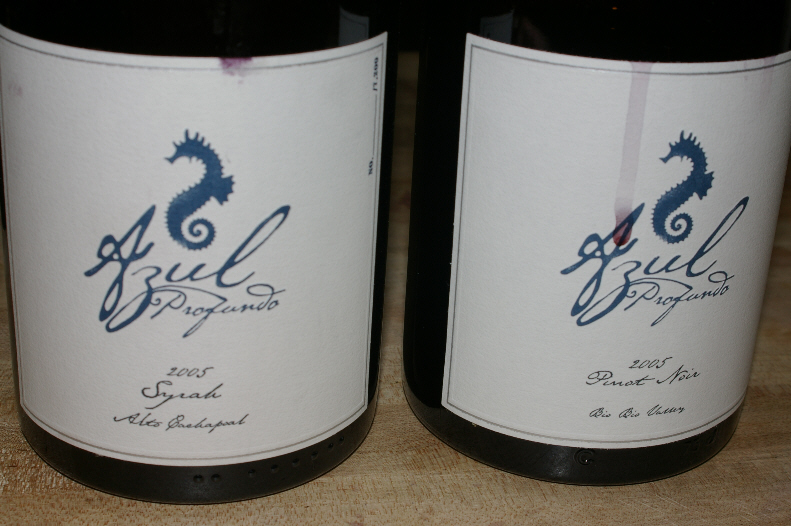
2005 Azul Profundo Syrah and 2005 Azul Profundo Pinot Noir (under $20) -- Chile. The Pinot reminds me of Jessica's Pinot by Porta as they are both from the Bio Bio Valley. Elegant with more fruit than Burgundy. Definitely not Russian River.
The Syrah is full-bodied with a long finish. A definite winner at this price point. Coming to Ohio very soon.


6 Comments:
I had the 2005 pinot and it was delicious!
Had this wine at NOLA, Emeril's restaurant in the French Quarter. Enjoyed it with Smoked duck and it was fabulous.
I had this at Commander's Palace in New Orleans this past weekend. It is fantastic, a new favorite. I enjoyed it with a terrific rack of lamb!
Where can I buy this fantastic wine! I had it in New Orleans recently and can't find it anywhere. I would love to know where I can purchase it.
You can get it from the Varietal...the wine makers themselves. Email Erin Meadows at erin@thevarietal.com!! They can ship to you!
Burgundy wine
(French: Bourgogne or Vin de Bourgogne) is wine made in the Burgundy region in eastern France.[1] The most famous wines produced here - those commonly referred to as Burgundies - are red wines made from Pinot Noir grapes or white wines made from Chardonnay grapes. Red and white wines are also made from other grape varieties, such as Gamay and Aligoté respectively. Small amounts of rosé and sparkling wine are also produced in the region. Chardonnay-dominated Chablis and Gamay-dominated Beaujolais are formally part of Burgundy wine region, but wines from those subregions are usually referred to by their own names rather than as "Burgundy wines".
Burgundy has a higher number of Appellation d'origine contrôlées (AOCs) than any other French region, and is often seen as the most terroir-conscious of the French wine regions. The various Burgundy AOCs are classified from carefully delineated Grand Cru vineyards down to more non-specific regional appellations. The practice of delineating vineyards by their terroir in Burgundy go back to Medieval times, when various monasteries played a key role in developing the Burgundy wine industry. The appellations of Burgundy (not including Chablis).
Overview in the middle, the southern part to the left, and the northern part to the right. The Burgundy region runs from Auxerre in the north down to Mâcon in the south, or down to Lyon if the Beaujolais area is included as part of Burgundy. Chablis, a white wine made from Chardonnay grapes, is produced in the area around Auxerre. Other smaller appellations near to Chablis include Irancy, which produces red wines and Saint-Bris, which produces white wines from Sauvignon Blanc. Some way south of Chablis is the Côte d'Or, where Burgundy's most famous and most expensive wines originate, and where all Grand Cru vineyards of Burgundy (except for Chablis Grand Cru) are situated. The Côte d'Or itself is split into two parts: the Côte de Nuits which starts just south of Dijon and runs till Corgoloin, a few kilometers south of the town of Nuits-Saint-Georges, and the Côte de Beaune which starts at Ladoix and ends at Dezize-les-Maranges. The wine-growing part of this area in the heart of Burgundy is just 40 kilometres (25 mi) long, and in most places less than 2 kilometres (1.2 mi) wide. The area is made up of tiny villages surrounded by a combination of flat and sloped vineyards on the eastern side of a hilly region, providing some rain and weather shelter from the prevailing westerly winds. T
he best wines - from "Grand Cru" vineyards - of this region are usually grown from the middle and higher part of the slopes, where the vineyards have the most exposure to sunshine and the best drainage, while the "Premier Cru" come from a little less favourably exposed slopes. The relatively ordinary "Village" wines are produced from the flat territory nearer the villages. The Côte de Nuits contains 24 out of the 25 red Grand Cru appellations in Burgundy, while all of the region's white Grand Crus are located in the Côte de Beaune. This is explained by the presence of different soils, which favour Pinot Noir and Chardonnay respectively. Further south is the Côte Chalonnaise, where again a mix of mostly red and white wines are produced, although the appellations found here such as Mercurey, Rully and Givry are less well known than their counterparts in the Côte d'Or. Below the Côte Chalonnaise is the Mâconnais region, known for producing large quantities of easy-drinking and more affordable white wine. Further south again is the Beaujolais region, famous for fruity red wines made from Gamay. Burgundy experiences a continental climate characterized by very cold winters and hot summers. The weather is very unpredictable with rains, hail, and frost all possible around harvest time. Because of this climate, there is a lot of variation between vintages from Burgundy.
You can find more info at: http://www.burgundywinevarieties.com/
Post a Comment
<< Home